SearchLane
Title Tag and Meta Description: Length, How to Write Them (+ Best Tips from Reddit)
How long a title tag and meta description should be, how to write ones Google keeps, and which Reddit tips about them are true.
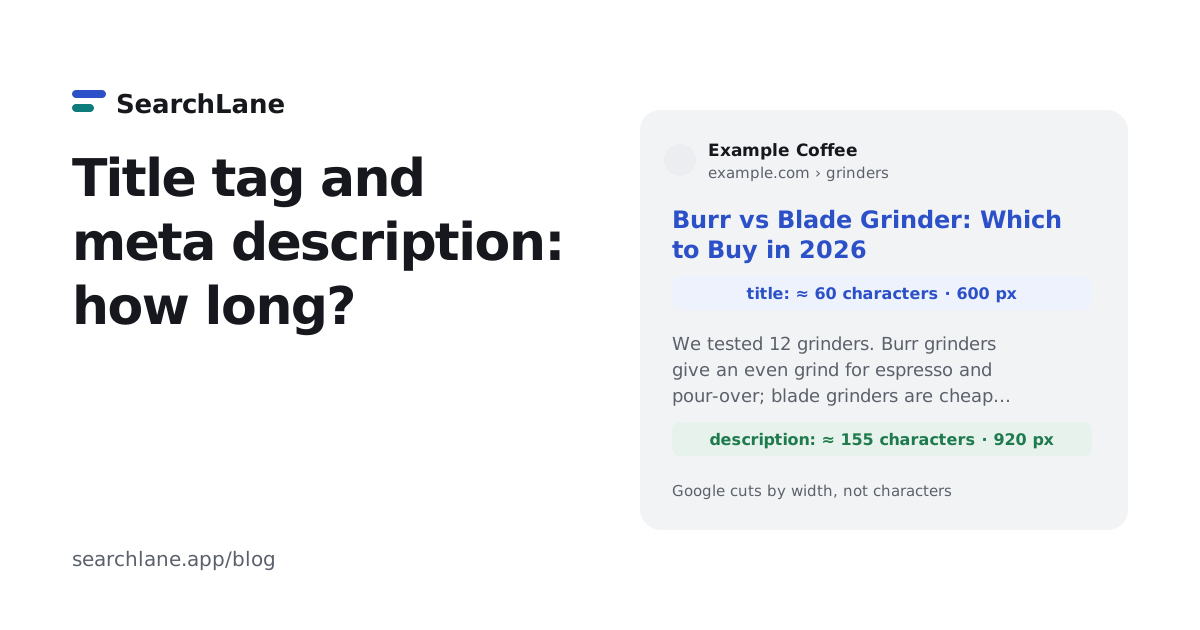
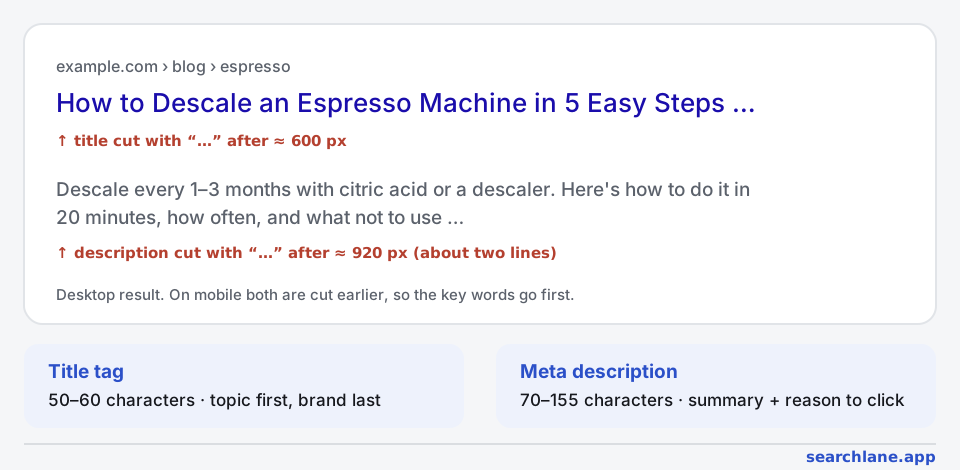
Keep the title tag under about 60 characters (600 pixels) and the meta description under about 155 characters (920 pixels on desktop), so Google can show them without cutting. Neither length affects ranking: Google doesn't limit how long they are and cuts them by screen width. What matters is that the title names the page's topic and the description sums up the page for the search. Google shows most titles as written but replaces the description more often than not when it finds text on the page that fits the query better.
What are the title tag and meta description?
The title tag is the <title> element in the page's <head>. Google uses it as the main source of the blue headline in search results, browsers show it on the tab, and social networks and AI tools use it as the page's name. The meta description is a <meta name="description"> element with a short summary. Google may show it as the snippet under the headline.
<head>
  <title>Burr vs Blade Coffee Grinder: Which to Buy in 2026</title>
  <meta name="description" content="We tested 12 grinders. Burr grinders give an even grind for espresso and pour-over; blade grinders are cheaper but uneven. See which fits your coffee.">
</head>
Among the sites our users checked with the SearchLane audit, 9 of 14 had pages with a title too long or too short, and 6 of 14 had pages without a meta description: they're the most common problems we find.
How long should a title tag be?
Aim for 50–60 characters, or about 600 pixels. Google has no limit on title length, but it truncates the title link to fit the device's width. Because the cut is by width, a title of wide letters (W, M) runs out sooner than one of narrow ones (i, l), so 60 characters is a guide, not a rule.
- Put the main topic first: on a phone, the end is the part that gets cut.
- Make each page's title unique. Google calls repeated, boilerplate titles a common reason it writes its own.
- Put the brand last, after a dash or a pipe, and only if there's room.
- Don't stuff keywords. Google lists keyword stuffing and overly long titles among the reasons it replaces a title.
How long should a meta description be?
About 150–160 characters, or up to 920 pixels on desktop. Google says there is no limit on how long a meta description can be; the snippet is cut as needed to fit the screen, and it's shorter on mobile. A description of 70–155 characters fits on most screens. A very short one, like a single phrase, gives Google little to use.
Does Google use my meta description?
Often, but less often than the title. Google builds the snippet from the page content and uses the meta description when it describes the page better for that particular search. A study by Ahrefs found that Google showed a different text than the meta description for about 63% of keywords (Ahrefs). Titles are much more stable: after its 2021 update, Google said it used the page's <title> about 87% of the time (Google).
That's why the same page can show your description for one search and a sentence from the page for another. It doesn't mean the tag is broken.
Do title tags and meta descriptions affect rankings?
The title does: it's one of the strongest signals of what the page is about. The meta description doesn't: Google has said it doesn't use the description meta tag for ranking (Google). The description still matters because it's often what people read before deciding to click.
How to write a title tag and meta description
- Start from the search. Find the words people use for the topic, for example with the keyword generator, and put the main one at the start of the title.
- Write the title as an answer to the search. Topic first, then what makes the page worth clicking: a year, a number, a format ("checklist", "examples"). Keep it to one idea.
- Write the description as a summary with a reason to click. Say what the page gives the reader in one or two sentences: the answer, the comparison, the price. Include the main keyword: Google bolds words that match the search.
- Make each page's pair unique. Templates are fine for large sites if they fill in page details, like product name, price and brand.
- Check the length. The SERP simulator shows where Google cuts both on desktop and mobile, by pixel width.
- Check what's on the live page. The Website SEO Checker extension shows the title and description of any open page with their length, and the site audit finds every page with a missing, duplicate or overlong one.
- Look at the results a few weeks later. In Search Console, compare clicks and CTR before and after. If Google still shows other text, make the description closer to what the page actually says.
Best tips from Reddit: what 4 threads say (and what's a myth)
We read four r/SEO threads about titles and meta descriptions, with 68 comments after removing duplicates. The most common point, in 9 comments, was that Google decides which description to show. That's true, though it's much less true for titles. The table has every tip that came up, checked against Google's documentation and published studies.
| Tip from Reddit | Comments | Our verdict |
|---|---|---|
| Write the description for the click: what's on the page, a benefit, a call to action, the keyword early | 8 | ✅ True. Google bolds matching words, and the description is what people read before clicking |
| Google decides which description to show, you can't force it | 9 | ✅ True for descriptions (replaced about 63% of the time). ❌ Not for titles: Google keeps about 87% |
| Keep descriptions under 150–160 characters and titles under 60–64 | 6 | ⚠️ A good guide against cuts, not a rule. Google has no limit and doesn't rank by length |
| Length doesn't matter at all | 4 | ⚠️ Half right. Not for ranking, but a cut title or description reads worse |
| Meta descriptions are irrelevant | 3 | ⚠️ Not a ranking factor, but often shown as the snippet |
| Measure in pixels, not characters | 3 | ✅ True. Google cuts by width |
| If Google shows random text, rewrite the description and improve the page | 3 | ✅ True. Google picks what describes the page best for the search |
| Long titles of 130–200 characters rank better | 2 | ❌ Unproven. One person's experience; Google advises against long, verbose titles |
| Let AI write descriptions within the limit | 1 | ✅ Fine, if each one is unique and checked |
Why does Google ignore my meta description?
The thread "Google not using meta description tag" started with a WordPress site whose snippet showed an image caption instead of the description. The top answer: "Regardless of what SEO plugin you use, it's ultimately up to Google if they use the description you're giving them" (r/SEO). The author also noticed that a site: search showed the right description while a normal search didn't. That's expected: the snippet depends on the query, and Google picks the text that matches it.
Two commenters cited studies saying Google rewrites about 60–70% of descriptions, which matches Ahrefs' 63%. But another claim in the same discussion, that titles "will almost never be cut off because Google rewrites them anyhow" (r/SEO), mixes the two up: Google keeps most titles as written.
Does the length limit matter?
This was the most heated debate. Six comments recommended staying under about 150–160 characters for the description and 60–64 for the title. Four said it doesn't matter, one in capitals: "It. Does. Not. Matter." Both sides are partly right. Length isn't a ranking factor, and Google doesn't set a limit. But the limit isn't about ranking: it's about whether people see the whole text. A description cut mid-sentence or a title whose key word falls past the cut gives fewer reasons to click.
Three comments pointed out that Google cuts by pixels, not characters: "150 W's take up more space than 150 I's" (r/SEO). Character counts are a fine shortcut, as another reply put it, but a pixel preview is more accurate.
Should titles be longer?
The most upvoted comment in the length thread claimed the opposite of the usual advice: "Most of my title tags are 130-200+ characters. I have seen a boost on pages when I changed them to longer title tags." Its author writes several variants for different search intents in one title, and Google shows the part that matches the search. Nobody posted data either way. Google's own guidance warns against unnecessarily long or verbose titles and keyword stuffing, and names them as reasons it rewrites the title. Test this on a few pages before applying it to a whole site.
How do Reddit users write meta descriptions?
In "How do you all write meta descriptions?" every answer said the same thing in different words: say what's on the page and give a reason to click. "Meta description has no ranking value directly, BUT a good description will help with CTR. Think like your audience, what do they want to click on?" (r/SEO). Four of the seven answers suggested a call to action, and four suggested using the main keyword, ideally near the start.
How we counted
- Threads (all r/SEO): Google not using meta description tag (May 2023, 20 comments after removing duplicates), Meta tag length limits - Does it matter? (June 2025, 33), Is Exceeding meta descriptions length actually a problem? (May 2023, 8), How do you all write meta descriptions? (July 2021, 7).
- We found the threads through Google results for questions about title and description length and read the pages saved on November 8, 2026. Three identical comments posted twice or three times were counted once.
- A comment counts toward a tip if it states that tip. One comment can count toward several. Jokes and side arguments aren't counted.
- Every tip was checked against Google's documentation and the studies linked above. Four threads show what practitioners repeat, not how all site owners work.
How do I add a meta description in WordPress?
WordPress doesn't add a meta description on its own: without an SEO plugin or a theme that does it, pages have none, and Google builds the snippet from page text. The title tag is set automatically from the post title and the site name.
- Install an SEO plugin if you don't have one: Yoast SEO, Rank Math or All in One SEO all add the fields.
- Open the post or page in the editor. In Yoast, the "Meta description" field is in the Yoast SEO box below the content or in its sidebar panel. In Rank Math, click "Edit Snippet" in the Rank Math panel. In All in One SEO, use the "Meta Description" field in the AIOSEO settings box.
- Write the description and update the post. The same field usually lets you change the SEO title without changing the post title.
- Set a template for the rest. Each plugin can fill descriptions automatically for posts, products and categories, for example from the excerpt. Write your own for the pages that matter most.
Shopify, Wix and Squarespace have the same fields in each page's SEO or search engine listing settings.
Title tag and meta description examples
| Page | Title tag | Meta description |
|---|---|---|
| Blog post | How to Descale an Espresso Machine (5 Steps) | Descale every 1–3 months with citric acid or a descaler. Here's how to do it in 20 minutes, how often, and what not to use. |
| Product | Baratza Encore ESP Coffee Grinder – Free Shipping | Burr grinder with 40 settings for espresso to French press. $199, ships in 24 hours, 1-year warranty. |
| Category | Burr Coffee Grinders: 24 Models Compared | Manual and electric burr grinders from $35 to $900, compared by grind range, noise and speed. Filter by brew method. |
| Local service | Plumber in Austin, TX – 24/7 Emergency Repairs | Licensed plumbers in Austin. Leaks, clogs and water heaters fixed the same day. Upfront prices, 4.9★ from 600 reviews. |
FAQ
What is the ideal meta description length?
About 150–160 characters, which fits in roughly 920 pixels on desktop. Google has no fixed limit and cuts the snippet by screen width, so put the most important words first. The length doesn't affect ranking.
What happens if a title tag is over 60 characters?
Nothing bad for ranking. Google cuts the title at about 600 pixels and adds an ellipsis, so words past that point aren't seen. Very long or keyword-stuffed titles are also more likely to be rewritten by Google.
Why does Google show a different meta description?
Google builds the snippet for each search and uses your meta description when it describes the page better than any text on the page. Studies find it shows other text for more than half of searches. A specific, accurate description that matches the page's content is used more often.
Do meta descriptions still matter?
Yes, but not for ranking. Google doesn't use them as a ranking signal, but they're often shown in results, and a clear one helps people decide to click. Pages without a description get a snippet built from page text, which is often less convincing.
Do meta keywords still matter?
No. Google said in 2009 that it doesn't use the keywords meta tag for ranking, and it still doesn't. You can leave it out. The title tag and meta description are the meta tags worth writing.
What do Reddit users recommend for meta descriptions?
In four r/SEO threads with 68 comments, the most repeated advice was to write the description for the click: say what's on the page, add a benefit or call to action and use the main keyword early. Commenters also agreed that Google decides whether to show it.
Add SearchLane as a preferred source on GoogleSee our new articles more often in Top Stories and Google's AI answers. How it works