SearchLane
Why Isn't My Page on Google? Fixing “Crawled – Currently Not Indexed” (+ Best Tips from Reddit)
What each 'not indexed' status in Search Console means, how to fix Crawled and Discovered – currently not indexed, and which Reddit tips work.
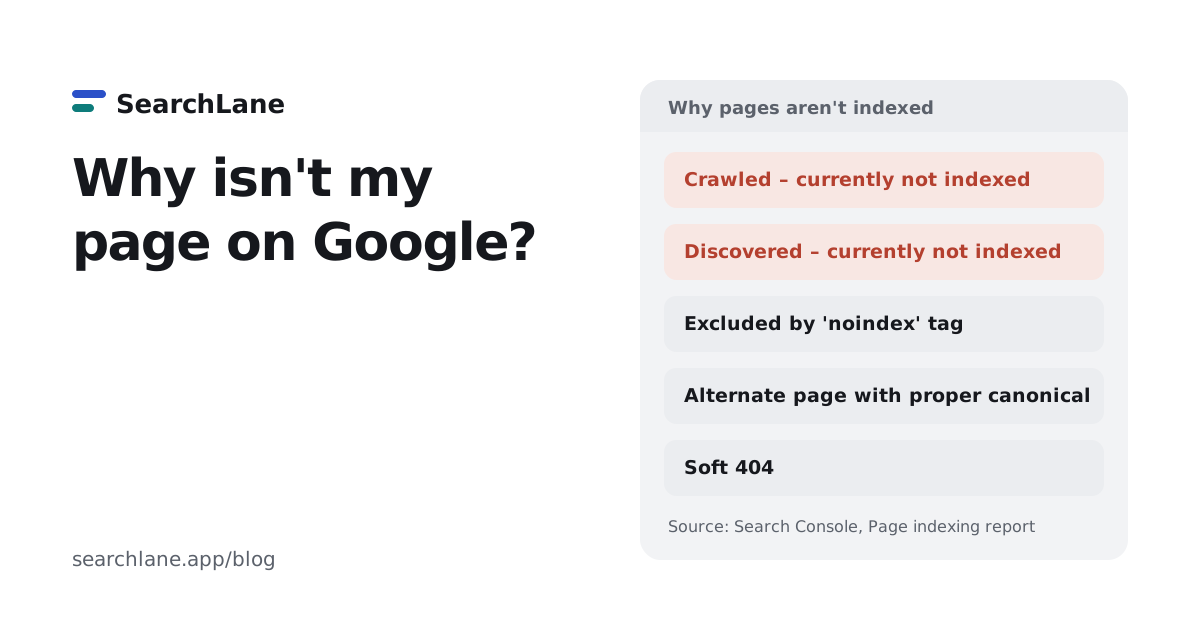
If a page isn't in Google, open it in Search Console's URL Inspection tool and read the status: it names the reason. Technical statuses like "Blocked by robots.txt", "Excluded by 'noindex' tag" or "Alternate page with proper canonical tag" have a direct fix. "Discovered" and "Crawled – currently not indexed" mean Google found the page and chose not to index it yet. For those, make the page clearly different from what's already indexed, link to it from your indexed pages, and give the site reasons to be trusted, such as links from other sites.
How to check if a page is indexed
- URL Inspection in Search Console is the only reliable answer. Paste the URL: "URL is on Google" means it's indexed, "URL is not on Google" comes with the reason.
- The Pages report (Indexing → Pages) lists every non-indexed URL Google knows, grouped by reason, under "Why pages aren't indexed".
- A
site:search likesite:example.com/pagegives a rough check without Search Console, but it can miss indexed pages.
Indexed isn't the same as ranking. A page can be in the index and still not appear for any search you try, including your brand name on a new site. That's a ranking problem, not an indexing one.
Why is my page not indexed by Google? What each status means
| Status in Search Console | What it means | Fix |
|---|---|---|
| Crawled – currently not indexed | Google fetched the page and decided not to index it for now | Improve the page and its links; see below |
| Discovered – currently not indexed | Google knows the URL but hasn't crawled it yet | Internal links, site speed, fewer low-value URLs |
| Excluded by 'noindex' tag | The page asks not to be indexed | Remove noindex if the page should be in Google. The meta tag checker shows the robots tag |
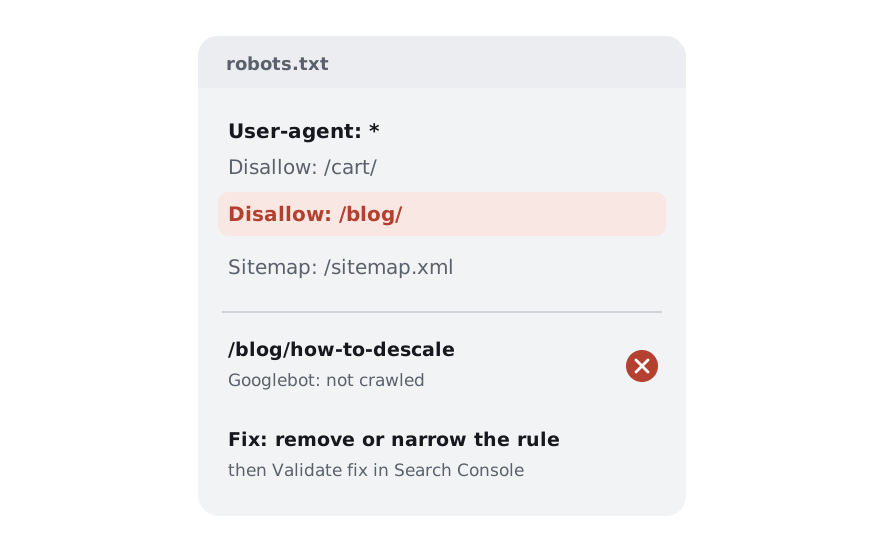
| Blocked by robots.txt | A robots.txt rule stops crawling | See Blocked by robots.txt or test the URL in the robots.txt checker |
| Alternate page with proper canonical tag | The page points its canonical at another URL, and Google agrees | Usually nothing: the other URL is indexed |
| Duplicate without user-selected canonical | Google found duplicates and picked another URL as the main one | Add a canonical tag to the version you want; test it with the canonical checker |
| Duplicate, Google chose different canonical than user | Google ignored your canonical | Make the pages less alike, or point links and the sitemap at your canonical |
| Page with redirect | The URL redirects elsewhere | Nothing, unless the redirect is a mistake. The redirect checker shows where it leads |
| Soft 404 | The page returns 200 but looks empty or like an error | Return a real 404, or add the missing content |
| Not found (404) / Server error (5xx) | The URL doesn't load | Fix links to it, or fix the server |
Source: Google's Page indexing report help. Several statuses are normal: redirects, canonicalized duplicates and deliberate noindex pages are supposed to stay out of the index.
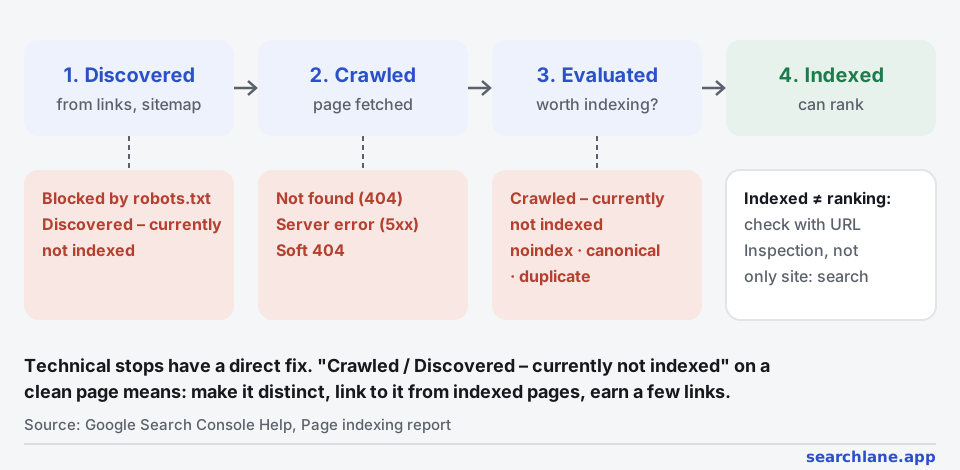
What does "Crawled – currently not indexed" mean?
Google says the page "was crawled by Google but not indexed. It may or may not be indexed in the future; no need to resubmit this URL for crawling." Google doesn't index every page it can reach. When the technical side is clean, this status is a judgment that the page doesn't add enough to what's already in the index, or that the site hasn't earned enough trust for Google to index all of it yet.
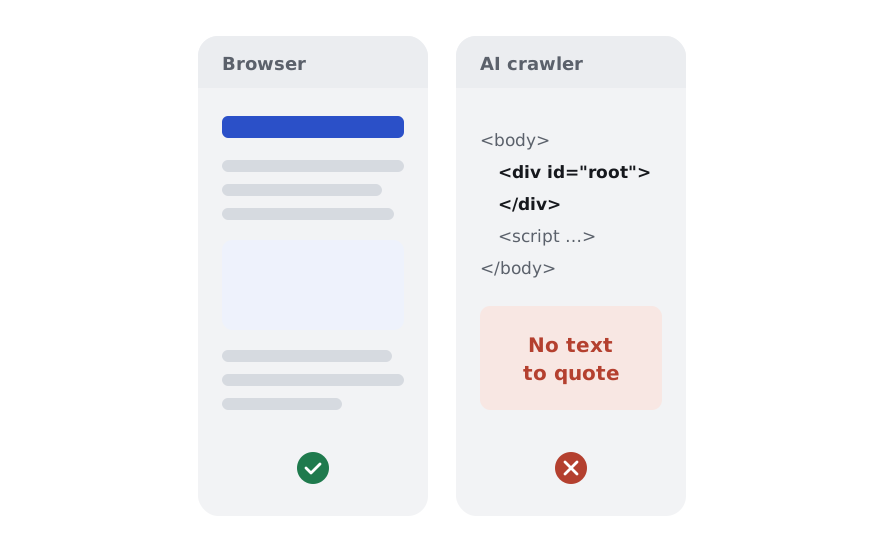
Before you assume that, rule out one technical cause that looks the same from outside: the page might look empty to Google. In URL Inspection, click "View crawled page" and search the HTML for a sentence from the middle of the page. If it's missing, the content loads with JavaScript and Google may have judged an almost empty page. See JavaScript SEO.
What does "Discovered – currently not indexed" mean?
The URL is known, from a sitemap or a link, but Google hasn't crawled it. Google says this typically happens when crawling it was expected to overload the site, so the crawl was rescheduled. On a new site, it also means Google doesn't yet see the pages as important enough to crawl. Check Settings → Crawl stats for server errors and slow responses, and make sure the pages are linked from pages Google has already indexed.
How to fix "Crawled – currently not indexed"
- Rule out technical causes. URL Inspection → "Test live URL": the page must be indexable, return 200, have a self-referencing canonical and show its main content in the crawled HTML. The site audit checks this for every page at once.
- Compare the stuck pages with each other. Pages built from one template with a few words swapped look like copies. Merge near-duplicates into fewer, stronger pages and redirect the rest.
- Add something only you have. Your own data, tests, photos, prices, examples or experience. Pages that repeat what's already ranking give Google no reason to index another copy.
- Link to them from the body of indexed pages. A link from the menu or a hub page is weaker than a link in the text of a relevant, indexed article. A page with no internal links at all may never be indexed.
- Earn a few links from other sites. On a new domain, a handful of relevant mentions or links often moves indexing more than any change on the page.
- Request indexing once after a real change. In URL Inspection, click "Request indexing". Repeating it for an unchanged page doesn't help, and the daily quota is small.
- Give it weeks, then look at the trend. Check the Pages report every few weeks. If the share of indexed pages grows, keep going; if it doesn't, the pages probably need more work, not more requests.
How do I get Google to index a page faster?
You can't force Google to index a page, but you can make sure it finds the page quickly and has a reason to index it:
- Request indexing in URL Inspection once the page is ready. It puts the URL in the crawl queue; it doesn't guarantee indexing.
- Add the page to your XML sitemap and submit the sitemap in Search Console. Google treats it as a hint about which URLs matter.
- Link to it from pages that are already indexed, ideally from the text of related articles and from the home page while it's new.
- Keep the page fast and returning 200. Server errors and slow responses make Google crawl less.
Google's Indexing API isn't a shortcut for ordinary pages: Google supports it only for job postings and livestream videos.
Best tips from Reddit: what 15 threads say (and what's a myth)
"Crawled – currently not indexed" is one of the most asked questions in SEO subreddits. We read 15 threads, with 169 comments, including one question cross-posted to eight subreddits in October 2026. Two explanations dominate, and they were argued as opposites: about 25 comments blamed authority and backlinks, and about 25 blamed thin or duplicate content. Google's documentation supports both: it indexes pages selectively, and trust and usefulness both play a part.
| Tip from Reddit | Comments | Our verdict |
|---|---|---|
| Get backlinks: it's an authority problem | ~25 | ✅ Often true on new sites, but not the only cause |
| Make each page unique; merge similar or templated pages | ~25 | ✅ True. Google picks one page from a group of near-duplicates |
| Add internal links from the body of indexed pages, not just the menu | 12 | ✅ True |
| Request indexing in URL Inspection | 8 | ⚠️ Once after a real change; repeating doesn't help |
| Content quality doesn't matter at all, only links | 7 | ❌ Contradicts Google, which says it may not index every page it crawls |
| Republish the page on a new URL | 6 | ⚠️ Unproven. If you try it, redirect the old URL |
| Be patient and keep publishing | 6 | ⚠️ Fine on a new site, but only with pages worth indexing |
| Check what Google actually fetched (crawled HTML, status codes, crawl stats) | 5 | ✅ True. Rule out technical causes first |
Use site: to check: indexed doesn't mean ranking | 5 | ✅ True, though URL Inspection is more reliable |
| Submitting a sitemap won't force indexing | 2 | ✅ True. A sitemap is a hint, not an order |
| Share pages on social media or run ads to send visits | 3 | ⚠️ Can help Google discover pages, but visits aren't an indexing signal |
Is it an authority problem or a content problem?
The longest thread, "'Crawled - currently not indexed' hell - No technical issues with the site", turned into a debate. One commenter described an experiment: a fresh domain with fully AI-written pages wasn't indexed for ten weeks, then got indexed within a week after "5 OKish backlinks" (r/SEO). Others argued the opposite: "it's usually content-related - low value, too similar, or not enough search demand."
The October 2026 question about 12 stuck pages on a new site got a more specific answer that several replies repeated: "If the 12 pages share one template with the data swapped in, Google often treats them as one page in twelve copies" (r/TechSEO).
Google's own wording supports both camps. It says it may not index every page it crawls, which rules out "only links matter", and on a young site with no links, few pages get indexed quickly. Fix both: make each page distinct, then earn a few links.
Do internal links help a page get indexed?
Twelve comments pointed at internal links, and the most specific advice was about where they go. One owner found that "the pages that got in were linked from pretty much every page and the stuck ones only had one link from a hub page" (r/SEO_tools_reviews). Another fixed 30 deindexed pages by removing keyword overuse, updating two-year-old content, reducing overlap with other pages and adding internal links (r/SEO).
Does requesting indexing or a new URL help?
Eight comments suggested "Request indexing". Google's own note on this status says there's "no need to resubmit this URL for crawling": requesting once after a real change is fine, repeating it changes nothing. Six comments recommended republishing the page under a new URL, because "slugs get caught inside Google systems". We found no evidence for that in Google's documentation. A new URL starts with no history and no links, so if you try it, redirect the old one.
What should you check before anything else?
Five comments pointed to technical checks that the thread authors had missed. In one thread a reply found that the site's framework added noindex to some pages dynamically (r/seogrowth). Another suggested running URL Inspection, opening "View crawled page" and searching the HTML for a sentence from the page: "If your tables or charts load from an API after the page renders, there's a decent chance the crawled version is mostly template and nav" (r/DoSEO). It's a five-minute check worth doing before anything else.
Is "my site isn't on Google" an indexing or a ranking problem?
In two "Website not showing on Google" threads, the owners could find their pages with site: but not by searching their brand name. As one reply put it: "just because the pages are indexed, it doesn't mean it ranks" (r/SEO). Two comments suggested checking the domain's history, since a reused domain or a name close to an established brand makes ranking harder.
How we counted
- Threads: "Crawled - currently not indexed" hell (r/SEO, May 2025, 49 comments), Help "Discovered – currently not indexed" in r/seogrowth (April 2026, 27) and r/SEO (5), 127 pages crawled not indexed and loss of position (r/SEO, June 2025, 16), "New website with 12 pages stuck on 'Crawled - currently not indexed'" cross-posted to eight subreddits in October 2026 (44 in total, for example r/TechSEO and r/DoSEO), Website not showing on Google (r/SEO, September 2025, 12), Website not showing on google (r/SEO, July 2025, 10) and Some pages of website not showing on Google (r/SEO, September 2020, 6).
- We found the threads through Google results for indexing questions and read the pages saved on November 8, 2026: 169 visible comments.
- A comment counts toward a tip if it recommends it. Counts marked "~" are rounded because many comments mixed several explanations. Comments promoting services and side arguments aren't counted.
- Every tip was checked against Google's documentation on the Page indexing report, sitemaps and URL Inspection. Reddit threads are written by people whose pages aren't indexed, so they show the problem, not how common it is.
FAQ
How long does it take Google to index a new page?
Anywhere from a few hours to several weeks. Pages on established sites with good internal links are often indexed within days. On a new domain with no links, it commonly takes weeks, and some pages may not be indexed until the site earns more trust.
Should I keep clicking "Request indexing"?
No. Request indexing once after you've made a real change to the page. Google says there's no need to resubmit pages marked "Crawled – currently not indexed", repeated requests for an unchanged page don't help, and the daily quota is limited.
Is "Crawled – currently not indexed" a penalty?
No. It's not a penalty or an error. Google crawled the page and chose not to index it for now, usually because it adds little beyond pages already indexed or the site is new. Improving the page, merging near-duplicates and adding internal links are the usual fixes.
Why does my site show with site: but not when I search for it?
Because the pages are indexed but don't rank for that search. On a new site, even the brand name may not rank until Google trusts the site, especially if the name is similar to an existing brand. Build links and mentions and make the brand name clear in the title and on the homepage.
What does Reddit recommend for "Crawled – currently not indexed"?
In 15 Reddit threads with 169 comments, the two main explanations were low authority (get backlinks) and thin or duplicate content (make each page unique and merge templated pages). Commenters also recommended internal links from the body of indexed pages and checking what Google actually fetched.
Add SearchLane as a preferred source on GoogleSee our new articles more often in Top Stories and Google's AI answers. How it works