 SearchLane
GEO vs SEO vs AEO: What's the Difference? We Analyzed 6 Reddit Threads
SEO ranks pages, GEO gets them cited by AI, AEO makes them the answer. Where they overlap, what 54 people on Reddit said, and what to do first.
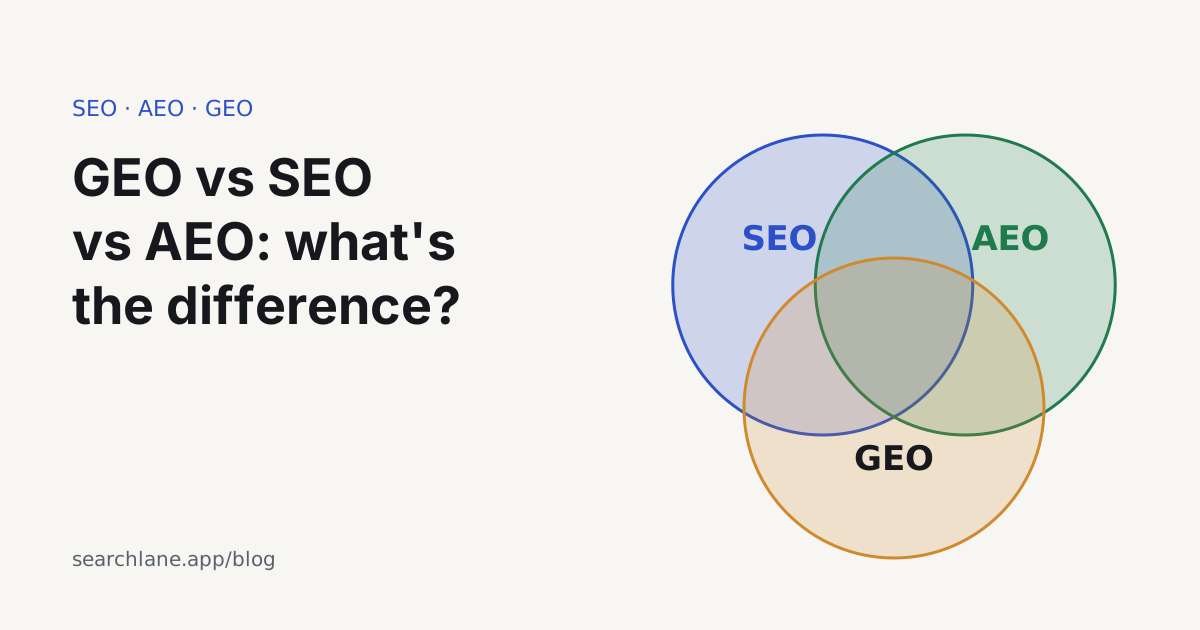
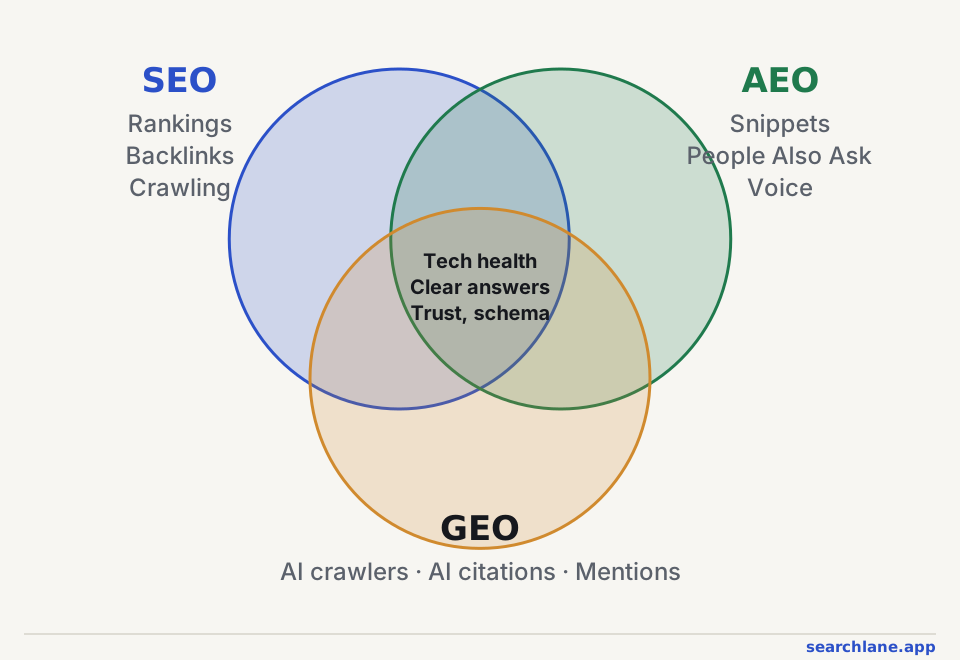
The difference between GEO and SEO is where you show up: SEO gets your pages ranked in search results, GEO gets them read and cited in answers written by AI. SEO (search engine optimization) is about the list of results in Google and Bing. GEO (generative engine optimization) is about AI assistants such as ChatGPT, Perplexity and Google's AI Mode. AEO (answer engine optimization) sits between the two and aims to make your content the direct answer, whether that's a featured snippet, a voice reply or an answer in a People Also Ask box. All three serve the same goal of being found when people search.
The terms are new and they overlap a lot. Below is how they differ and where to start.
GEO vs SEO vs AEO at a glance
| SEO | AEO | GEO | |
|---|---|---|---|
| Stands for | Search engine optimization | Answer engine optimization | Generative engine optimization |
| Where you show up | Blue links in Google and Bing | Featured snippets, People Also Ask, voice assistants | ChatGPT, Perplexity, Claude, Copilot, Google AI Overviews and AI Mode |
| What wins | The best page for a query | The clearest short answer | The most quotable, trustworthy passage |
| What you measure | Rankings, clicks, traffic | Snippets and boxes won | Mentions and citations in AI answers |
| Since | Late 1990s | Mid-2010s | 2023 |
SEO: be in the results
Search engine optimization covers everything that helps a page rank: pages that can be crawled and indexed, fast templates that work on phones, content that matches what people search for, internal links, and backlinks from other sites.
It is still the foundation, because AI answers are built on search results. Google's AI Overviews and AI Mode use Google's index, Copilot uses Bing's, and ChatGPT search and Perplexity run web searches before answering. If a page doesn't rank for any of those searches, it rarely gets cited.
AEO: be the answer
Answer engine optimization started with featured snippets and voice search. When Google shows an answer box or Alexa reads out a reply, a single source gets used, and AEO is about being that source. The usual advice:
- answer the question in the first 40 to 60 words under a heading worded like the question;
- use lists for steps and tables for comparisons;
- add structured data where it accurately describes the page;
- cover the follow-up questions people tend to ask next.
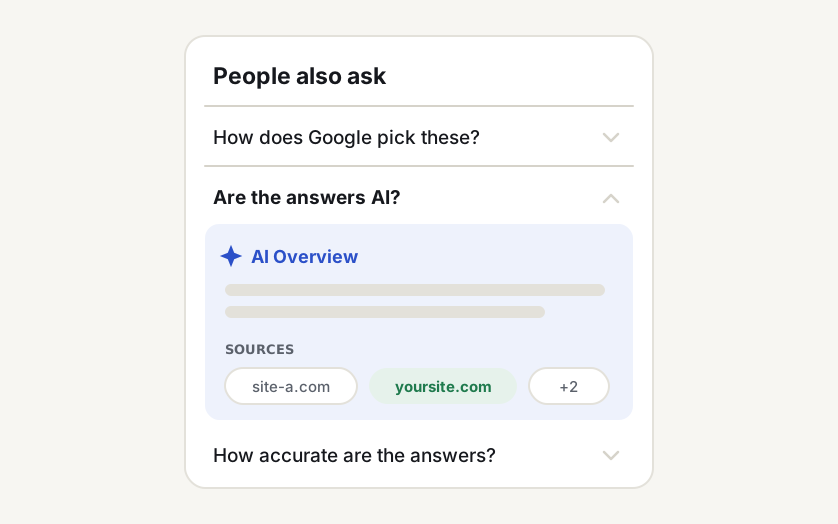
The same habits help with AI answers, which is why many people now treat AEO and GEO as one thing. It shows in Google's results too: by 2026 most answers in the People Also Ask box are AI Overviews, as we found in our own sample.
GEO: be cited by AI
Generative engine optimization keeps the AEO habits and adds a few things specific to language models.
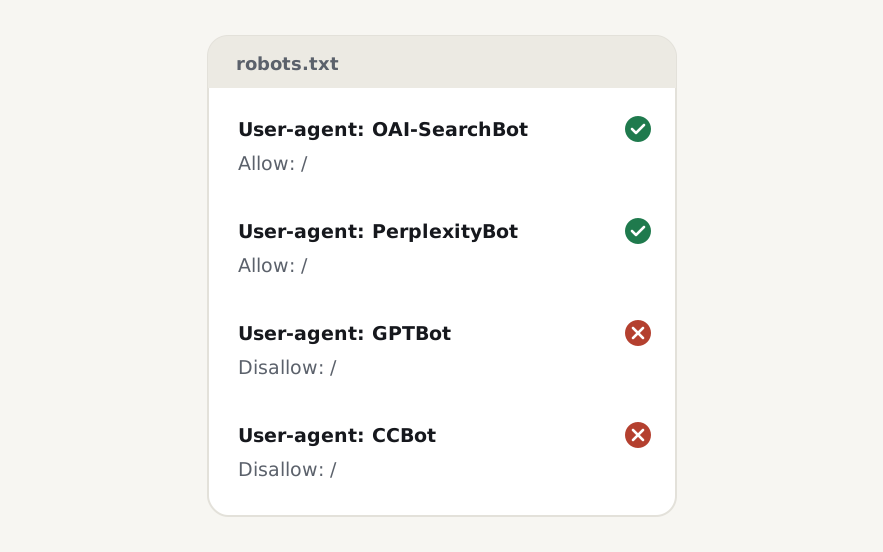
ChatGPT, Claude and Perplexity crawl with their own bots. If robots.txt blocks them, or the content only appears after JavaScript runs, those assistants can't use your pages. AI crawlers and robots.txt lists the bots and the rules.
Models quote paragraphs rather than whole pages, so each section should make sense when read on its own.
Sources, quotations and specific numbers make a passage more likely to be used. The original GEO study measured up to 40% more visibility from changes like these.
Assistants also name brands that come up in reviews, comparisons and discussions on other sites, so a good page alone isn't always enough.
Our practical guide to GEO goes through each of these in more detail.
What is the same in all three
All three depend on a technically healthy site: pages that load, return a 200 status, can be indexed and can be read without JavaScript. They all reward headings that match real questions and paragraphs that answer them straight away. They all favor pages that show who wrote them, when, and on what sources. And structured data helps each of them read the facts on a page correctly.
Fix these first, since the work counts in every channel at once.
Are GEO and AEO different from SEO? We analyzed 6 Reddit threads
We read six Reddit threads from 2025 and 2026 where marketers argued about exactly this, in r/WebsiteSEO, r/aeo, r/digital_marketing, r/GenerativeSEOstrategy and r/seogrowth: 107 visible comments from 72 people. Of the 54 who took a side:
| Position | People | Share |
|---|---|---|
| SEO is the base; GEO and AEO add a layer on top | 33 | 61% |
| It's the same work under a new name | 18 | 33% |
| Different mechanics, a separate discipline | 3 | 6% |
- The main argument for the "layer" view is that AI answers are built on search: "You almost never get pulled into an AI answer for a query you rank nowhere for" (the top reply in r/aeo).
- The "same thing" camp was smaller but louder. "When Bing started taking a share of Google's search market, we didn't change the name to BEO," as one reply in r/WebsiteSEO put it. Another, in r/aeo, called AEO "SEO in a trench coat".
- The differences people could name were specific. One was reviews and listicles: "Yelp reviews do nothing for traditional SEO, but AI often cites Yelp" (r/WebsiteSEO). Another was forums: "in-depth reddit threads and quora answers are getting cited way more than polished 'thought leadership' pieces" (r/digital_marketing). The third was measurement: you track mentions and citations, not positions.
- The names still confuse people. A thread in r/seogrowth asked how GEO differs from local SEO, reading "geo" as geography.
How we counted
We found the threads through Google (site:reddit.com searches on the topic) and saved them on October 10, 2026, with every visible comment. We counted people, not comments: each person once per thread, by the position they took. We didn't count the thread's author, replies that only asked a question or made a joke, or five replies that promoted a product or service. An AI model sorted the replies into positions, and we checked each label against the reply itself. Removed and deleted comments aren't included. People who answer on Reddit aren't a random sample of site owners, so read the shares as the mood among practitioners, not as a survey.
The threads:
- Is AI SEO (GEO/AEO) actually different from traditional SEO, or is it just SEO with a new name?, r/WebsiteSEO, October 2026
- What is the big difference between GEO and Local SEO?, r/seogrowth, September 2025
- AEO vs. SEO vs. both: How are you guys balancing optimization for LLMs and traditional search right now?, r/aeo, June 2026
- Most 'GEO experts' are just selling rebranded SEO and it's getting embarrassing, r/digital_marketing, May 2026
- Confused between SEO and GEO. what should I focus on for my brand?, r/GenerativeSEOstrategy, February 2026
- SEO vs. GEO – how are you thinking about the difference? Any good courses?, r/GenerativeSEOstrategy, April 2026
Our analysis: what the documentation and data say
| What people said | What the documentation or data shows | Verdict |
|---|---|---|
| No ranking, no citation | Google's AI Overviews and AI Mode use Google's index (Google). ChatGPT search uses OAI-SearchBot and search partners (OpenAI), and Copilot uses Bing | True, but it depends on whose ranking |
| Reviews and listicles count for more in AI answers | Our check: asked for "the best garage door repair company in St. Paul MN", ChatGPT cited five sites. Three were rankings and directories (Expertise.com, GarageDoorList and the BBB), and none of the five was in Google's top 10 for the same search in St. Paul. Google's top 10 had Yelp and Reddit instead, which ChatGPT didn't cite | Supported in our check: AI answers lean on rankings and directories, and not the ones that rank in Google |
| It's the same work under a new name | The basics overlap, but the measuring doesn't: Search Console's Generative AI report shows impressions without clicks, Bing reports AI citations, and OpenAI offers site owners no report at all | Partly true: the work overlaps, the measuring is new |
We ran these checks through DataForSEO on October 11, 2026 (US, English); one run per question unless stated, so treat them as examples, not a study.
What we recommend: do the SEO basics first, then check the places AI answers actually cite for your topic, which may be rankings, directories and review sites that don't rank in Google at all, and make sure you're on them.
What to do first
For a small business, the SEO basics plus answer-first content already cover most of AEO and GEO. After that:
- Run a technical audit for indexing problems, broken links, duplicate titles, missing schema and blocked AI crawlers. Our free website audit checks for both SEO and GEO problems.
- Allow the AI search crawlers in robots.txt (at least
OAI-SearchBot,PerplexityBotandClaude-SearchBot), even if you keep the training bots out. - Rewrite your 10 most important pages so each main heading is followed by a one-sentence answer, with the detail after it.
- Choose 20 to 50 prompts and track them every month, with your Google rankings and your mentions in AI answers side by side.
FAQ
Is GEO going to replace SEO?
No. AI assistants find pages through search before they answer. ChatGPT search and Perplexity run web searches, Google's AI Overviews and AI Mode use Google's index, and Copilot uses Bing's. GEO is a layer on top of SEO, and a page that doesn't rank for those searches is rarely cited.
Will AEO replace SEO?
No. AEO is the part of SEO that targets answer formats such as featured snippets, People Also Ask and voice replies. The answer still comes from a page that is indexed and ranks, so the SEO basics remain the foundation.
Is AI SEO called GEO?
Often, yes. GEO, AI SEO, LLMO (large language model optimization) and AI search optimization are names for roughly the same work: getting content into answers written by AI. Some people use "AI SEO" for doing SEO with AI tools, so check which meaning is intended. We cover both in AI SEO explained.
Is AEO the same as GEO?
They overlap, but they aren't the same. AEO targets a single direct answer, like a featured snippet or a voice reply. GEO targets AI-generated answers that combine and cite several sources. Most of the tactics, such as clear answers, good structure and schema, help with both.
Is SEO still worth it in 2026?
Yes. AI answers are built on search results, so ranking still decides which pages can be cited, and the results themselves still send visitors. The difference is that a click is no longer guaranteed, so being cited in an AI answer matters as much as the ranking.
What does Reddit say about GEO vs SEO?
In six Reddit threads we analyzed, 33 of the 54 people who took a side said SEO is the base and GEO and AEO add a layer on top. Eighteen said it's the same work under a new name, and three called it a separate discipline. The most common argument was that AI answers draw on pages that already rank.